
Debunking debunking
An invitation to consider your 'why' before jumping on the debunkery bus

Debunk: v. to expose a claim, belief, or theory as false, exaggerated, or misleading, often by presenting evidence or logical analysis
I love to give my therapy clients a general introduction to something called polyvagal theory1 to help them understand the probable “why” behind anxiety, depression, out-of-control emotions, or the ways past traumas continue to hamper their ability to live the lives they want to live. In my experience, PVT helps people normalize and accept dysfunctional behaviors and emotional states that they haven’t been able to shift.
Since I started working in this way with clients, I’ve understood that it is a theory (not a set of facts)—a model or framework that reflects human experience and biology enough to be clinically useful.
I know how I felt when I learned this framework, applied it to my own pathologies, and began to use it for my own healing: relieved, inspired, resonant.
I see the same kind of relief come up for clients as they come to comprehend that their bodies’ unconscious safety mechanisms—not a fatal flaw in their psychological operating systems—may underpin their psychological (and, sometimes, physical) suffering.
This model validates clients’ experiences and gives them hope around improving how they function and feel. I LURVE it.
And…PVT is in a moment of widespread debunking.
Debunkers include highly respected scientific researchers (39 of them contributed to the linked scholarly article), therapists, coaches, and interested laypeople.
Some of these folks are getting their intel from scholarly sources (although not enough of them are getting it from the theory’s creator, neuroscientist Stephen Porges, who published this rebuttal). Others are debunking based on information they’ve received via (fundamentally) a game of ‘telephone’ on social media.2
Of course, debunking is an important part of building knowledge.
Here are but a few previously accepted theories that were, thankfully, debunked:
The geocentric universe: of COURSE the Earth is at the center of everything! (Not.)
The miasma theory of disease: that we get sick because of bad air or foul smells.
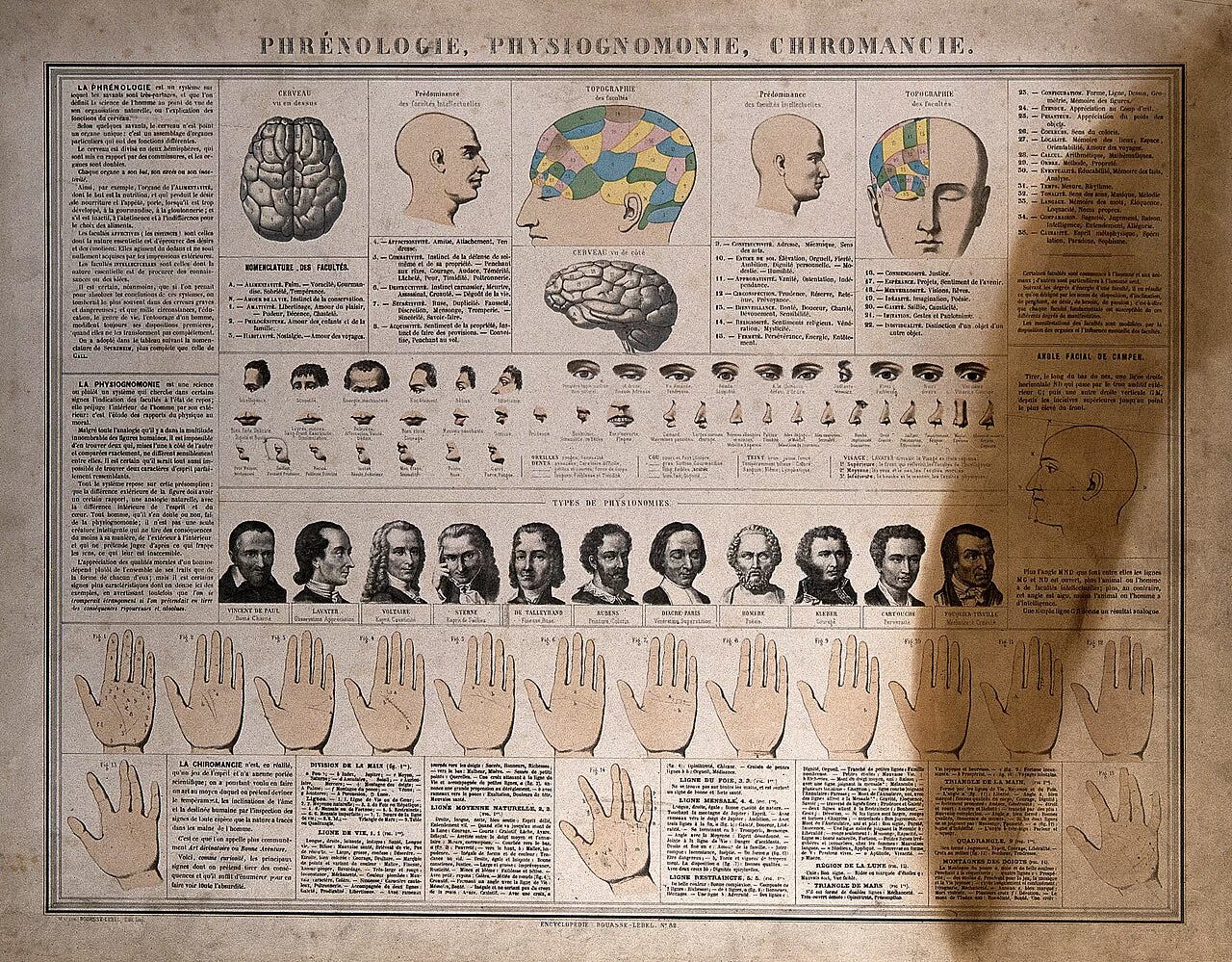
Phrenology: claims that personality traits could be read from bumps on the skull.
Eugenics: eeeew.
The ‘four humors’: it was once believed that health required a proper balancing of the four ‘humours’ (blood, phlegm, yellow bile, black bile).
A lot of what Freud told the world to believe: for example, that human pathopsychology rests solely on the thwarting of aggressive or sexual drives.
Martian canals: The belief that straight lines visible in telescopic views of Mars were canals built by intelligent Martians.
And yet. Can we agree that sometimes our reasons for debunking something…
are not exactly pure wishes to bring down the bad guys and foment good?
Wanna get clicks and likes? Get on the debunkitty-bus!
“Thought it was CARBS that packed on those postmenopausal pounds? Think again! Scroll to find out about ONE SIMPLE TRICK that…”
“They told you to lift heavy weights to build muscle! But would you believe that this has been TOTALLY DISPROVEN? Click here to get to your best beach body EVER by June…”
Wanna feel like you’re one of the in-the-know peeps who can look down on others in judgment?
Debunking a respected notion or theory can do this for you, and more!...
Do you, like me, detect a delight, an almost-schadenfreude, that arises when a sacred cow is tipped, or (glee!) when we are the one to tip it?
Do you, like me, want others to know you have this special knowledge that something lots of people believe…is not true? Because this would make me…Very Important?
I have felt the aforementioned glee before.
During my stint as an anti-vaxxer (technically, a vaccination-debunker) back in the early ‘00s, I felt it.
Those poor souls, they just don’t know. If only they had better information. I’ll get it out there as best I can. I’ll spread Truth. They’ll thank me.
(This stint ended abruptly for me after both my unvaccinated young children spent a month feverishly cough-barking and bazooka-barfing after catching whooping cough in a community with a lot of other unvaccinated children. We traveled by plane early on in their illness, before we knew they were sick. Thinking of how we could’ve infected vulnerable people on that trip still makes my guts twist with guilt.)
But while I maintained my anti-vaxxer position, which at the time was even less popular than it is now, and in which I truly believed, I won’t lie:
it felt really good to think I knew better.
We gravitate toward debunking and tipping sacred cows when things feel out of control.
When the complexity and dualities and legit flippin’ Zen koans of existence feel overwhelming.
It can feel easier, simpler, in those moments to tear something down than to lean into building something better from what’s already been created; to ask reasoned questions that may even increase the complexity of what we are investigating.
“Gotcha! NOT TRUE! Now I know!” can deliver a temporary blip of certainty.
Before I get on the debunkery bus, I wish to check in about whether this “MWAHAHAHA!” is what I’m actually after.
And I wish to refrain from unnecessarily adding my own debunkish bark to the current din and confusion.
My hope is that to not cloud the field with debunkery engaged in as a strategy to soothe myself, to feel right, to feel better-than.
I am inviting you to do the same.
PVT, developed by neuroscientist Stephen Porges, PhD, attempts to explain how the autonomic nervous system (ANS)—the branch of the nervous system that regulates involuntary body functions like heartbeat, breath, digestion, and blood pressure—responds to stimuli indicating threat or safety. PVT divides the ANS into three response systems: sympathetic, which triggers ‘fight or flight’ responses when danger is perceived; ventral vagal, which supports social engagement and states of calm or positive activation; and dorsal vagal, which produces shutdown, collapse, or ‘freezing’ states. The ANS engages more or less constantly in neuroception, scanning the environment for indicators of danger or safety, and the information gathered via neuroception directly impacts the state of the brain and body. Specific thoughts can get coupled with the body sensations and behaviors linked to threat. This is one way to understand how the brain and body can get stuck in dysfunctional states; as a clinician, much of how I work centers around shifting these states through both cognitive and somatic psychotherapies.
I won’t get into the scienc-y details here about the debunkishness. Suffice it to say that the argument between debunkers and supporters is kind of an apples-and-oranges one. Critics name legitimate issues with some of the neuroanatomy and evolutionary science underpinning PVT, but none of them has really demonstrated that it isn’t useful or does harm. On the other hand, MANY clinicians aside from myself have stepped up to defend it as helpful, filling a need that previously was unfilled in clinical practice, and worth preserving/evolving.
Fun read but don’t know exactly what you are suggesting ? Or is it just a review ?